
Series: The Other $85 Trillion | Article 7
Positioning for Luck
In June 2007, my co-founders and I started Happen. Fourteen months later the global financial system collapsed, and it turned out to be the luckiest thing that ever happened to us. I've written about that before, and the short version I usually reach for is: we didn't predict the crash, we'd just built something specific enough to be standing in the right place when it landed. It's a good story. Going back through this piece, I think it undersells what we actually did, and I'll come back to that at the end.
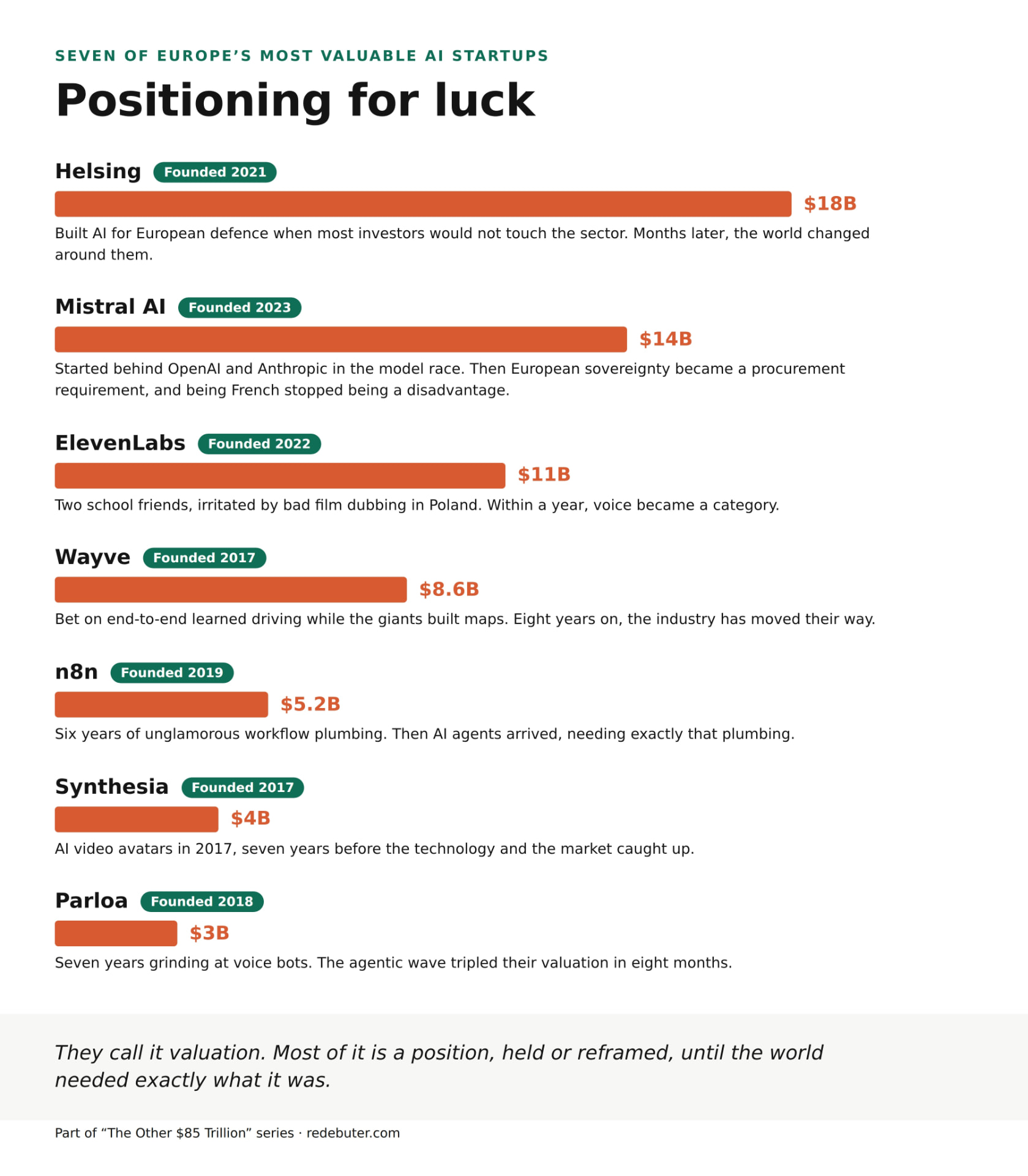
A chart did the rounds recently, Europe's most valuable AI startups, and it tempted me into a version of that same short story for seven of the companies on it: an unfashionable position, held for years, vindicated when the world changed around them. I drafted a post along those lines and, before publishing it, went back and checked the dates, the founding quotes, the first investor cheques. What I found split the seven into three different stories, and only one of them is really luck.
None of this is a new observation, and it would be a bit rich to pretend otherwise. Bill Gross, the founder of Idealab, gave a widely watched TED talk in 2015 comparing two hundred startups on five factors, and timing beat team, execution and the idea itself, by his numbers. His own headline example was Airbnb, which launched into a recession when people needed the extra income from a spare room. He paired it with a company called Z.com, same conviction, same execution, that folded because broadband arrived two years too late. Every VC pitch deck template has had a "why now" slide for a decade, for exactly this reason. If you've sat through an accelerator, you already know timing matters more than founders like to admit.
What that slide and that talk don't cover is what it's like inside the years before you find out which one you are. The "why now" question gets answered once, at the seed round, in front of people who want to hear yes. Nobody asks you to answer it again in year three, when the board wants to know why revenue still hasn't moved, and the true answer might be that you don't yet know if you were right. That's the part I actually want to look at here.
The ones who saw it coming
Start with Helsing, now valued at $18 billion. Torsten Reil has said the idea for a European defence AI company goes back to 2014, to Russia's annexation of Crimea. He and his co-founders understood, in his words, roughly what was going to happen. They didn't want to think it through, because thinking it through meant confronting what defence actually costs, in every sense. They hoped it might go away. It didn't, and in 2021, seven years after the warning they'd chosen not to act on, they founded the company anyway. Daniel Ek's Prima Materia backed them with a €100 million seed round that November, three months before Russia's full invasion of Ukraine made the thesis undeniable to everyone else. That's not a company that got lucky when the world changed. That's a company founded on a specific, dated, uncomfortable prediction, delayed by very human reluctance, then funded by someone willing to believe it before the proof arrived.
Wayve tells a harder version of the same story. Alex Kendall founded the company in 2017 with a contrarian bet: that a single neural network, trained end to end, would eventually outperform the hand-built, modular systems every serious autonomous vehicle company was building. He wasn't ignored. He was told directly that he was wrong. When I went and pitched these ideas, he's said, they told me end-to-end learning will never be safe. Waymo, Tesla and Cruise had collectively spent tens of billions of dollars on the approach he was arguing against. Eight years later, most of the industry has drifted toward something closer to his answer. That's not luck meeting position. That's a position held against the field's stated judgement, for the better part of a decade, until the field came around.
Mistral belongs in this group too, though I got the mechanism wrong the first time. My instinct was that Mistral started behind, GPT-4 was already out when they founded in April 2023, and got lucky when European sovereignty became fashionable. The record says something more specific. The €105 million seed round that June, then the largest in European history, was raised largely on the founders' own account of a sovereign European AI strategy, a plan articulated at founding, more than a year before Brussels made data sovereignty a live procurement question. Being behind on raw model capability was real. But the position they actually built the company on, Europe needs its own AI it can run on its own terms, was there from month one. What changed later wasn't the thesis. It was how quickly and how completely the rest of Europe agreed with it.
Parloa is the smallest and quietest of these four, but the pattern holds. Malte Kosub ran one of Europe's first agencies dedicated to voice-driven experience for years before he founded Parloa in 2018, specialising in a category most people hadn't decided was worth specialising in. When large language models finally made conversational AI genuinely good, five years later, he wasn't arriving at a new opportunity. He was already standing in the room.
Four different companies, four different specific insights, held for years, at real reputational and financial cost, against explicit or implicit rejection from people who knew the field. Whatever else this chart tells you, it isn't simply a story about being in the right place when the dice landed well.
The one who moved fast
ElevenLabs is a different shape of story, and a shorter one. Mati Staniszewski and Piotr Dąbkowski founded the company in April 2022 because they'd spent their childhoods in Poland wincing at badly dubbed American films, a real, specific, personally felt problem, which is exactly the kind of insight this whole conversation about position tends to start from. But the gap between founding and the moment wasn't eight years, or seven, or five. It was seven months. ChatGPT launched that November and voice became a category almost overnight. ElevenLabs is proof that a founding insight doesn't need a decade to be real. It needed the world to catch up by less than a year, which is a very different kind of position to hold than Wayve's or Helsing's, easier to sustain and harder to take full credit for.
The two I nearly filed under foresight, wrongly
My first pass put n8n and Synthesia in with Helsing and Wayve. Closer reading changed my mind, because the story I wanted to tell was tidier than the one that actually happened.
n8n was not built for the AI wave. Jan Oberhauser launched it in 2019 as an open-source workflow tool, and three years later it was doing fine. Solid, in his own words. Not outstanding. Then generative AI arrived, and rather than watch it make his product obsolete, he rebuilt it for AI in eight weeks. Revenue that had grown steadily for three years quadrupled in the following eight months. There was no seven-year wait, no rejected pitch, no founding thesis about artificial intelligence. There was an open, flexible architecture that happened to be reconfigurable quickly, and a founder who moved the moment he saw what was coming. That's not foresight. It's something almost as valuable and much less romantic: the discipline to notice a shift early and rebuild fast, rather than defend what you'd already built.
Synthesia's story needed correcting more than any of the others. The founding thesis in 2017 wasn't enterprise training video. It was Hollywood, and it didn't work. The first few years were, in Victor Riparbelli's own description, pretty awful, and most people who looked at the company thought the founders were simply wrong, not visionary. Around 2021, four years in, Riparbelli realised the people who actually needed what he'd built weren't film studios. They were large organisations that needed to make onboarding and training videos quickly, in dozens of languages, without a camera crew. That's not a position held for seven years and finally rewarded. That's a company that missed its first market entirely and deliberately rebuilt itself around a second one it could actually see working. The map most founders draw at the start is rarely the territory they end up standing on. Synthesia's early map pointed at Pixar. The territory turned out to be corporate PowerPoint, at Bosch and Zoom and Merck.
Where Happen actually sits
Which brings me back to where I started, because I think I've been telling my own story too modestly.
We didn't predict the 2008 crash. Nobody in this piece gets credit for that kind of prediction, not even Reil, who predicted the war rather than the market. But we did have a specific, dated conviction about what was wrong with the innovation industry as it stood in 2007, and we built Happen to be the opposite of it. The boom-era agency world we were leaving looked, to us, wasteful and self-indulgent: Hawaiian shirts and earrings, a lot of talk about transformation, very little accountability for whether any of it worked. Transformation was the useful word, because it bought years of runway with no obligation to show a result, and by the time anyone might have checked, the people who'd sold it had usually moved on. Failures were routinely masked by growth that had nothing to do with the work itself, so nobody had to reckon with the ones that didn't land. We thought that was wrong, and we built something commercial and accountable instead, work you could trace to a number on a client's P&L.
We also thought the tools the industry used to test and develop ideas were stuck in the 1980s, still running on the innovation equivalent of Nielsen BASES, slow, expensive and disconnected from how people actually behaved. So we built Winkle - one of the very first online market research platforms for innovators, years before that became the obvious way to do it.
None of that predicted a financial crash. All of it was a real, held position about what the industry had got wrong, taken before anyone agreed with us, in exactly the way Reil's Crimea conviction or Kendall's end-to-end bet were real positions before anyone agreed with them. What the crash did wasn't create our position. It stripped away the cover that had let a wasteful industry survive, capital that used to fund lofty transformation work overnight, and the market went looking for exactly what we'd already built. That's closer to Helsing and Wayve than to n8n's eight-week rebuild. The luck wasn't in the position. It was in how quickly and completely the world came round to agreeing we'd been right about it.
What this actually means
So: is it foresight, or is it luck? Both, and the ratio matters more than the chart lets on.
Five of these, Helsing, Wayve, Mistral, Parloa, and Happen, were built on a specific conviction, held for years, often against direct professional rejection or plain indifference, and the world eventually organised itself around what they'd already decided was true. One, ElevenLabs, had a real personal insight that needed the world to catch up by months rather than years. Two, n8n and Synthesia, didn't predict anything. They built something adaptable or specific enough to move fast when the actual moment showed up, and then they moved.
The useful question isn't which of these you'd rather be. It's which one you actually are, because the leadership behaviour each demands is different. Holding a Wayve-shaped position for eight years against your own board's scepticism takes a kind of stubbornness that will occasionally be wrong and ruinous. Moving an n8n-shaped position in eight weeks takes the opposite instinct: a willingness to abandon a plan that was working adequately the moment a better one becomes visible. Confusing the two is how organisations end up either stubborn about the wrong thing or hasty about the right one.
The same question usually sits somewhere inside your own product pipeline, not just theirs. Most businesses have an idea everyone's quietly agreed is too early or too niche, which is often just a more comfortable way of saying nobody's prepared to back it.
There's a way to tell the difference before the world decides for you. Foresight is rarely a prediction about the future. It's usually something already true, backed by a signal that's already visible, which the people around you, sometimes including you, have quietly agreed to write off as noise. Reil didn't predict a war. Russia had already annexed Crimea, and the signal sat there, discounted, for seven years before Helsing existed to act on it. We didn't predict a financial crash either. We just refused to keep pretending the innovation industry wasn't already wasteful, years before anyone else in it was willing to say so out loud. A plan you're just defending doesn't have a signal like that behind it. It survives on "the market isn't ready yet," which is usually just a more comfortable way of not naming what's already in front of you.
And the chart, like every chart of winners, only shows you the seven who were right. Somewhere in Europe there is a founder who held a Wayve-shaped conviction for eight years and was simply wrong, and another who tried an n8n-shaped pivot into a wave that never arrived. Their companies aren't on anybody's list. That asymmetry is worth remembering before anyone, including me, turns seven data points into a formula.
Bill Gross can tell you, looking back, that timing explained more of the variance than anything else. What he can't tell you, and what the "why now" slide was never designed to answer, is what to do with yourself in year three, when the market hasn't yet decided whether you're Airbnb or Z.com, and the only evidence you have is the same conviction you started with. That's not a diligence question. It's a leadership one, and it's the one worth asking yourself before the chart tells you which you were.
Which are you holding: a position you've decided to defend for years before anyone agrees with you, or a plan you're one good week away from rebuilding?
Sources: Bill Gross, "The single biggest reason why start-ups succeed," TED (2015); Torsten Reil, various interviews including The Venturist (June 2026) and Contrary Research; Helsing funding history, Dealroom and Defense News (July 2026); Alex Kendall, Sequoia Capital podcast and BusinessDesk interview (2025-2026); Arthur Mensch, Business Insider and 20VC interviews; Mistral AI seed round reporting, TechCrunch and Learn AI (2023-2026); Malte Kosub, World Economic Forum contributor profile; Jan Oberhauser, Felicis Ventures and Sequoia Capital interviews (2025-2026); Victor Riparbelli, GV interview and Upstarts podcast (2026).